A musical interlude, brought to you by the didgeridoo

Outback's second and final album.  Used copies can still be found on Amazon.com and likely elsewhere.

Outback’s second and final album. MP3 versions and used CDs can still be found on Amazon.com and likely elsewhere.

Maybe the fact that I’m headed to Australia in another six months made me more open to the musical wonders of the didgeridoo, but I’ve definitely become a fan after hearing Outback’s “An Dro Nevez” on the internet station Radio Paradise in April.

I immediately bought what turned out to be the only two albums Outback ever produced, and they were a bargain — both were used CDs purchased on Amazon.com, and they cost more in shipping (about $3 each) than I paid for the discs themselves. I’ve been wearing them out since, as I find them both interesting enough to listen to but relaxing and unobtrusive enough to be good working music (at least one friend has called Outback repetitive, which I get, but I think it’s great stuff).

Baka, Outback’s first album, was No. 1 on Billboard’s world music chart. Despite its clear Australian ties and influences, Outback can’t really be called “Australian,” although the didgeridoo itself (also spelled “didjeridu”) is an invention of Australia’s Aborigines.

Outback was formed in 1988 by Graham Wiggins and Martin Craddick.  As is often the case, the history of these musicians and their various bands is quite varied and interesting, but perhaps moreso because Wiggins started inventing his own forms of the didgeridoo while a graduate student in physics — a field in which he earned a doctoral degree from Oxford.

After Outback broke up in 1992, Wiggins begain performing as Dr. Didg.  He’s almost certainly the only guy to ever play with the Grateful Dead (you can hear the session at the linked site) and reach an equal pinnacle of success in scientific fields — radio-frequency engineering and magnetic imaging. He’s currently a senior researcher for the Center for Advanced Imaging Innovation and Research in New York City.

Outback's first album was a world-music hit.

Outback’s first album was a world-music hit.

Some of his work can still be found on Soundcloud, including Serotonality (a piece that gives some indication of why he probably was invited to play with the Dead). His web site, Wikipedia bio and Facebook page seem to indicate he no longer plays professionally.

I’ll write more later on the didgeridoo and, I hope, Dr. Didg, as I’ve been learning a bit more about the instrument and expect it and other aspects of Australian music will be a big part of my Winterim 2015-16 COMM 373 course.

For now, I’ll leave readers with another YouTube version of the same song linked at the beginning of this post.  Half the fun of music is listening to — or watching — different presentations of the same stuff, so here’s another video featuring the same musical version of “An Dro Nevez” and some nice footage of a couple of guys riding through the Australian outback with Ural motorcycles and sidecars. (Never heard of Urals?  Me neither).
 

Hey, Aussies … stop making fun of us. We’re tougher than you think.

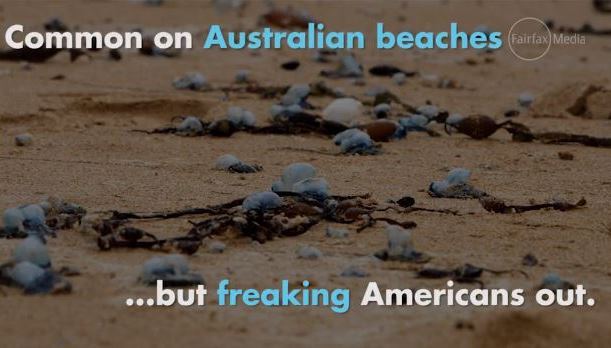
Just one of these has caused panic on the East Coast, but they're common in Australia.

Just one of these has caused panic on the East Coast, but they’re common in Australia. (Screen capture from Fairfax Media video)

Australia is home to more deadly creatures than any other continent, and the typical Aussie response is to pooh-pooh their dangers. But that doesn’t mean folks in Oz should hit us below the belt when something comes along that we’re not used to.

This amusing report pokes fun at New Jersey’s response to the unusual appearance of a single bluebottle, also know as the Portuguese man of war.  Complete with ominous music, the accompanying video makes light of a situation that’s rare in Jersey but in Australia occurs frequently and with far greater numbers of bluebottles.

Granted: the Jersey folks overreacted.  But not all North Americans are wimps.  Wisconsinites have dealt with strange creatures that would send shivers down the spines of even the toughest Australians.

“It has more things that will kill you than anywhere else.” Bill Bryson on Australia

Yes, Oz is well known for the extraordinary presence of venomous bugs, snakes and even mammals, not to mention other dangerous creatures like great white sharks and the cassowary.  Bill Bryson’s book In a Sunburned Country  devotes a great deal of discussion to this charming aspect of the Land Down Under.

Continue reading

A little more Friday good news from foreign lands

What a great end to the week it’s been for folks who see beyond their own personal leanings or pocketbooks.  The Supreme Court’s landmark decisions on health care and gay rights were absolutely the right things to do; for many people, they were also quite unexpected, and I count myself in that group.

Maybe it’s just being a resident of a state that has gone bass-ackwards in the last five years.  In education, natural resources and parks, health care, and social services, it seems we’ve done all the wrong things.

I’ve lowered my expectations to the point that seeing a public institution genuinely act in the public interest is a jaw-dropping experience. Mine hit the floor so hard and often this week that I’m fortunate to have teeth left.

Lost in the really big news this week is a smaller story out of New York City, a place as urbane and symbolically far removed from Wis-Gone-Sin as you can get and still stay on the same continent. Central Park has been closed to cars, starting this evening.

The New York Times quoted Mayor Bill de Blasio’s written statement on the closure.  “Like all public space, our parks have a lot of demands put on them,” the mayor said. “But traffic shouldn’t be one of them. Our city needs places where kids can run around safely, where people can jog or go for a walk after a long day of work and not have cars racing by five feet away.”

If you love parks and the outdors, this is great news. If you care about the health of people and cities, this is great news.

Ultimately, the vast majority of people probably fit into at least one of those two groups, although some people in them may forget about those values when short-term or profit-oriented factors come into play.

That’s why it’s so delightful to see this change made for the good of all.  Like social stability and good health care, our parks and public spaces, even if not all of us use them, bring untold value to our shared communities.

Let’s hope more of our so-called leaders in Wisconsin start getting the message.

Good news is a reminder to all of us that we can help these things happen. Speak up. Keep up the pressure.

Maybe we can make our state part of the nation again.