MAPS.ME: A very handy offline map for travelers

If you’re one of those rare souls who aren’t connected all the time but have yearned for a good electronic atlas, MAPS.ME may be the next best thing.

Maps.ME gives wonderful detail and has a useful search function.

MAPS.ME gives wonderful detail and has a useful search function. (Sorry for the dark image — used another new app, Mobizen, for capturing the screen image but haven’t quite mastered the details.)

I’m one of the few who have yet to adopt a smartphone, but I do rely on my Nexus 10 tablet for a few things during travel.  The offline atlas that I’ve wished for may be here in its closest form with this Android app.

MAPS.ME is available for free in the Google Play store.  I also found it in Amazon’s Andoid App Store, but not the iTunes Store.

I’ve always been a hard-copy map guy.  The size and detail of an atlas or a laminated foldup map appeal to me far more than the miniature, highly focused capsules of the world given to us in a standard GPS screen, and I’ve seen too many folks who are slaves to their GPS while being completely unaware of their surroundings. Continue reading
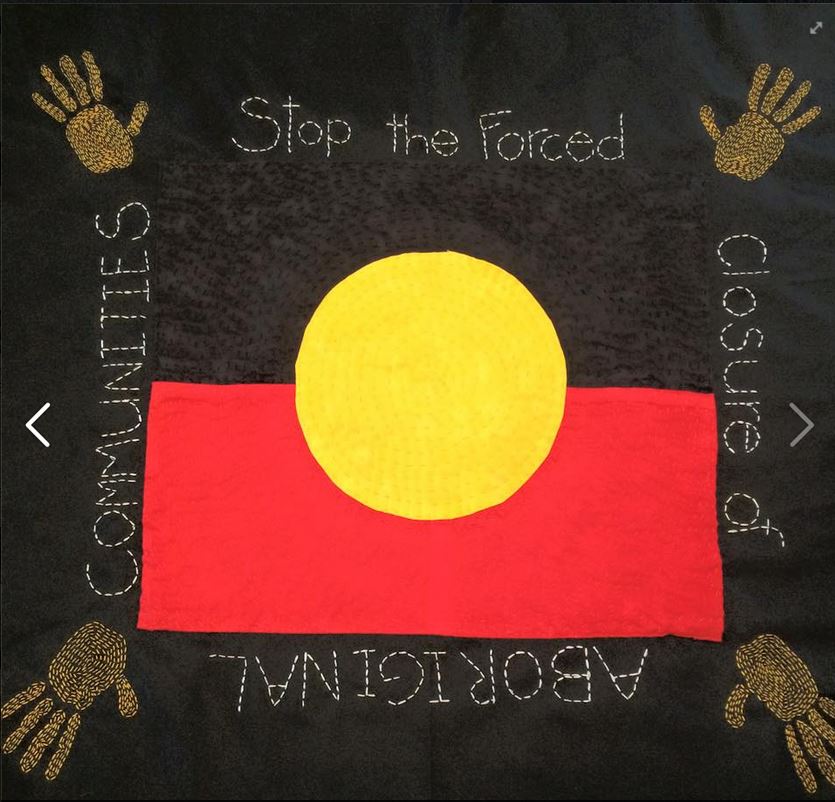
Closing of Aboriginal communities drawing worldwide attention

closure

Click here to go to the Facebook page “Stop the Forced Closure of Aboriginal Communities in Australia”

As we prepare for our winterim trip to Sydney, we’ll examine more news like this.  A story this morning in USA Today on the potential closure of up to 150 Aboriginal communities in Western Australia is part of a steady worldwide stream of  articles and stories about this issue.

The official government stance is that this is an issue of expense, but Aboriginal rights groups, independent and liberal media, and others are suggesting could be related to international interest in uranium and other mining.  Critics, such as Natalie Cromb in this Independent Australia piece, call the government “puppets for multinational corporations.”

There is, of course, an activist Facebook page related to this issue, and I’ll be following it as part of my effort to keep updated on this issue (along with more mainstream media).

Clearly, this is a complex issue, and I’ve just begun to search out information myself.  Given that our course, COMM 373, is entitled “Communication and Social Change,” issues such as this will clearly be worth following over the next few months.

Here are a few links to international media stories about the potential closures:

I was hoping to find something from China Daily, but the best I could get was a paywalled version of the Agence Presse-France report linked above.

Watch my blog for more Australian news and updates on this story.

Thanks to Professor Mark Tolstedt, coordinator of the Australia winterim program, for sending the link today to the USA Today story.

Australian travel videos: A quick, incomplete primer

Click to visiti Lonely Planet's YouTube channel video on Uluru.

Click to visit Lonely Planet’s YouTube channel video on Uluru.

A little research goes a long way in virtually any area, and travel videos are no different. It helped me turn a quick review of one video into a discovery of a couple of other video sources that I’ll link toward the end of the post.

The post started as a review of another International Programs offering, a video on Southeastern Australia that was also produced by Lonely Planet.  While the 45-minute disc, featuring former English footballer, travelogue host and comedian Ian Wright, was not exactly to my taste, it might be worth the time spent for some COMM 373 student.  The disc can be checked out from the IP office.

I found the video less informative and only slightly entertaining; perhaps it’s Wright’s style that doesn’t do much for me.  Quirky like much of Lonely Planet’s work, the 2005 video focuses mostly on five different cities in the Australian Southeast, but the focus is often scattered, overly brief or lengthy, and trivial.  Frankly, had I seen this on TV, I might have switched channels in the first five minutes, most of which was spent on Wright making light of an annual country music festival in Tamworth, the “Nashville of Australia.”

Continue reading

Late at night, the boabs cut loose and wander about

(Lonely Planet’s Australia guidebook)

Highly recommended

Highly recommended

UWSP’s International Programs office keeps several of the well regarded Lonely Planet guides, including the 2013 edition of its 1,106-page Australia guide to the entire country.  One would expect this publisher’s Australian guides to be particularly good, as the company is based in Melbourne, and its story (which is included in the back of most of its guides, as well as online) will probably appeal to the average student, as it involves a beat-up car, a penurious budget and an idea.

Lonely Planet says great guidebooks should “inform, educate and amuse,” and most readers would likely agree that this book does a solid job of that.  Its sheer size means there’s plenty of information; that raises questions about whether it’s too massive to cart around on a short-term trip or whether it’s more than is needed for students who will generally be limited to the southeastern portion of the country.  It will definitely be useful for those able to do post-trip travel to other parts of this equally massive country (the world’s sixth-largest — the U.S. is fourth and about 20 percent larger than Australia).

Continue reading

Best Australian guidebooks? Depends …

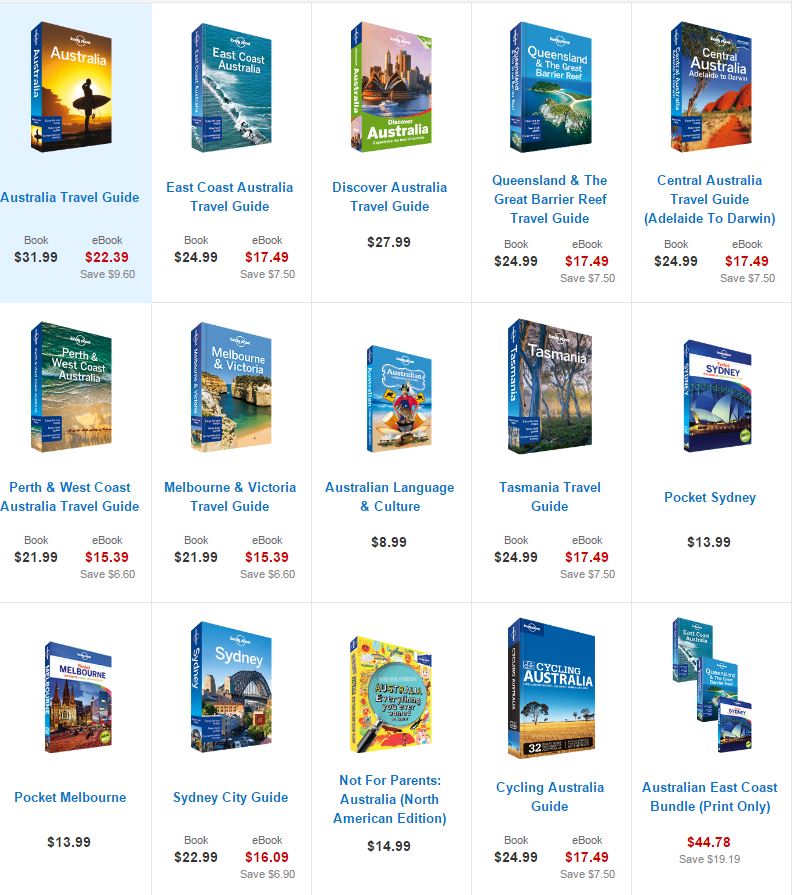
Lonely Planet has 15 different guidebooks for Australia alone (click the picture to go to its Australia products).

Lonely Planet has 15 different guidebooks for Australia (click picture to see its page).

One of the great services provided by the UW-Stevens Point International Programs office is its library of guidebooks and other resources. If you’re thinking about the Australia winterim 2015-16 trip, you can check out several guidebooks or videos and learn a bit more about what Australia has to offer.

Among them are the Lonely Planet printed guidebooks to Australia and to Sydney & New South Wales (where the UWSP winterim is focused), as well as that publisher’s DVD version of “Australia: The South East.”  I’ll be reviewing each of these, as well as a number of other guides and resources, over the next few months.

It turns out Lonely Planet started as an Australian company, so one would expect its Australia products to be excellent.  (It does guidebooks for the world, though — it recently listed 489 different ones on its web page.)

Continue reading